
The best procurement decisions do more than fill a need on paper. They solve operational challenges that directly affect performance, labor, guest experience, and growth.
Operators usually reach out because something is not working the way it should. Labor is tight. Equipment is underperforming. Results are inconsistent. Lead times are disrupting the business. Growth is becoming hard to manage.
We don’t believe in just placing an order and moving on. We work to understand the problem behind the request and recommend a solution that improves the operation both in the short and long term.
Turning Operational Pain Points into Procurement Strategy
Since COVID-19, labor has been a consistent challenge that operators bring to us.
For example, the dish room is a big pain point, because it is hard to staff, hot, and a workhorse of a job. But what if a dish machine that once required four people to operate could now be run by one? The other 3 people could be reallocated to roles with more value and customer touchpoints.
That is 75% labor savings driven by a single equipment change. That is not a marginal improvement – it is a meaningful operational shift.
When we solve a pain point a client has been living with for years, and the solution actually works, that is when the value really clicks.
Smart Procurement Strategy Creates Smoother Outcomes
At The Hub, we become the single point of contact for overseeing the sourcing, specification, and purchasing of equipment, furniture, and smallwares. We are able to align the right partners around customers’ needs and tailor the approach based on what they actually need help solving.
That matters because no two clients are the same. Solutions will look different depending on the challenge. They could include:
- Streamlining purchases and order tracking
- Optimizing specifications
- Improving alignment across vendors, dealers, staging, and delivery
- Helping smaller companies leverage our contracts to buy like larger organizations
- Finding cost and labor efficiencies without sacrificing functionality
Our job is to bring experience, relationships, and systems together so the process runs as smoothly as possible.
We use our experience, knowledge, expertise and systems to identify and prevent problems before they even happen.
How Equipment Decisions Can Reshape Performance
Usually, the clearest sign that it is time to rethink an equipment decision is tied directly to operational output.
It could be that the equipment is not performing the way the operator needs it to; it is not delivering consistent results, or it keeps breaking, or it cannot be delivered in the timeframe the business needs.
Those are usually the moments when someone raises their hand and asks for help.
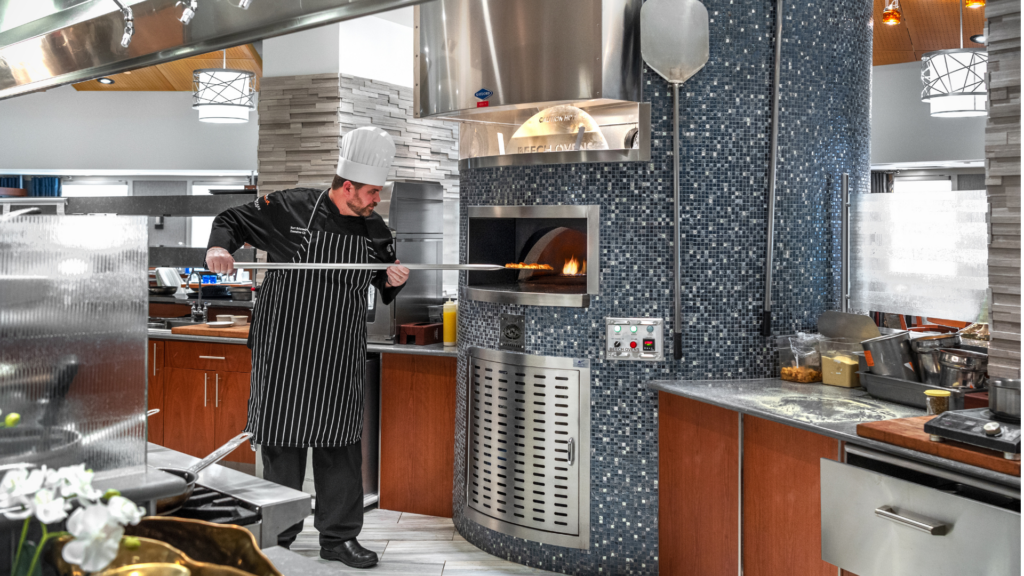
For example, if a venue is selling 150 pizzas a day and it takes 12 minutes to cook each one, that cook time is not just a kitchen detail. It affects throughput and line management. If the business needs to get that cook time down to nine minutes to keep customers moving, the right oven recommendation changes the performance of the whole line.
That is why even a single equipment decision can have outsized impact. The right answer is not always the one the client started with. It is the one that gets them closer to the result they actually need.
Standardization as a Foundation for Growth
This principle becomes even more important when a concept is trying to grow.
We worked with a West Coast restaurant chain that had been buying equipment through a local dealer. They had also hired an architect and designer who were not strong foodservice specialists, and that was translating to problems in the field.
Drawings were not clean. Specs were not consistent. Equipment was not fitting the way it should. Deadlines were getting harder to hit, and procurement had become a constant scramble.
They knew they wanted to expand, but they also knew the way they were operating was not going to scale.
We came in, brought in the right dealer partners, helped create a prototype for the store, cleaned up the drawings, and established clearer specifications so the process became standardized instead of improvised.
That changed the conversation from one-off purchasing to a repeatable model they could actually build from.
You don’t get to be a Shake Shack or a Chick-fil-A and buy every store individually.
Brilliant chefs and founders often know exactly how to build a concept people love. What they may not have built yet is the procurement and specification discipline that takes a business from local success to regional or national scale. That is where the right partner can make a real difference.
Innovation, Technology, and The Future of Strategic Procurement
Technology and innovation, when used thoughtfully, have the power to change how a guest experiences a space.
A good example is a toaster for a self-serve breakfast. Everyone has stood at the belt toaster waiting three minutes for a bagel to come through. It feels slow, even awkward. It makes the space feel inefficient.
We are looking at technology now that can do that same job in 30 seconds, with better consistency and no preheating. That kind of improvement may sound small, but it changes the guest’s experience.
Sometimes it’s the smallest things that make the biggest difference when it comes to equipment, completely changing how the guest experiences the space.
Because of The Hub’s position in the market, and the strength of Compass and our relationships, suppliers often bring us innovation before it reaches the broader market. They want our perspective on whether it has real value in the business, and when it does, we can help bring that technology to customers much earlier than they would otherwise see it.
When I attended Host Milan this year, I was introduced to a German robotic warewashing system that we are now working on piloting as the first of its kind in a U.S. hospital. That is the kind of innovation we pay attention to because it has the potential to solve a meaningful operational problem.
Technology and data will never replace knowledge and experience, but it will help enhance how we’re able to effectively solve customer problems.
Partnership as a Long-Term Advantage
For some firms, a procurement relationship is transactional. The order is placed, the job is done, and they move on.
At The Hub, we don’t see it that way.
We have the capabilities to support everything from concepting and architecture to purchasing, installation, warranty cataloging, after-service agreements, and preventive maintenance.
We have a vested interest to make sure customers get the best solution and equipment possible for their operation because our people are there after everyone else leaves.
To us, procurement decisions are not just about getting the order through. They are about helping the operator perform better after the equipment arrives, after the install is done, and after everyone else has moved on.