
In senior living, where trust and care define the experience, brand is not just a symbol or tagline. It reflects values, revealed in daily moments: the warmth of a greeting, the attentiveness of care, the consistency of service. Operators and marketers understand this intuitively, yet many still wrestle with a familiar challenge: how to reconcile the urgency of short-term performance with the slower work of building long-term brand equity.
Census goals and budget cycles often dominate attention. But when brand is overlooked or fragmented, communities risk losing more than visibility. They lose cohesion and the long-term value that comes from a reputation rooted in purpose and delivered with consistency.
Brand is not a campaign. It’s a resident experience.
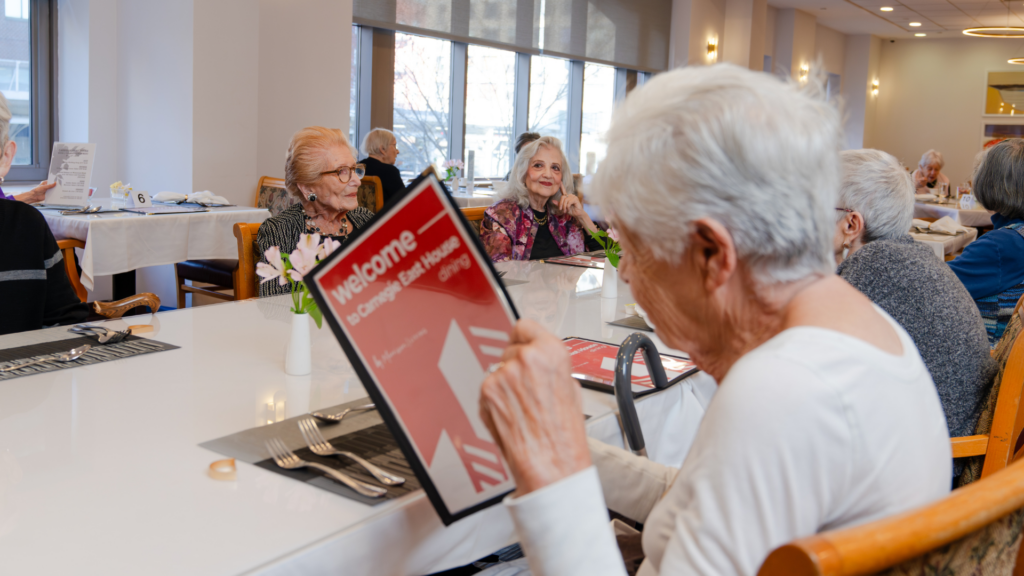
The complexity of branding in senior living lies in its reach. A brand is not a campaign. It’s a resident experience. It lives in the way teams engage, in the feel of the dining room, in the stories shared with prospective families. That was the case at Carnegie East House in New York City, where a thoughtful reimagining of the dining program became the foundation for broader brand alignment. Updated messaging, a stronger digital presence, and consistent tone across channels elevated the community’s identity in a saturated market, strengthening engagement inside and out. Read the full case study here.
Why Brand Equity Matters More Than Ever
In an industry defined by personal connection and emotional decision-making, brand is not a luxury. It is a necessity.
For communities, brand functions as a lens, shaping how residents, families, and staff interpret every interaction. It clarifies purpose, influences perception, and, more than any single brochure or ad, earns trust. In a landscape where offerings often look similar, a strong brand is what makes a community feel different.
Done right, brand delivers four essential functions:
- Clarity – helping people understand what the community truly stands for
- Consistency – building confidence through aligned experiences
- Differentiation – distinguishing the community in a crowded field
- Connection – forging emotional bonds that outlast transactions
But brand equity is not built in bursts. It’s earned through continuity, how reliably a community lives up to its promise. That might mean a longstanding reputation for hospitality, a culture of wellness, or a philosophy centered on dignity and independence.
The business case is clear. A 2025 survey by Harvard Business Review Analytic Services found that 93 percent of leaders believe long-term brand building is essential to growth, yet only 36 percent feel their organizations are effective at it. The gap between intent and execution remains wide, but for those willing to close it, the payoff reaches far beyond lead generation.
In a landscape where offerings often look similar, a strong brand is what makes a community feel different.
Successful Marketing and Branding Work Together
In many organizations, branding and marketing are treated as separate disciplines, one strategic, the other tactical. But in senior living, they are interdependent.
Branding defines the promise. Marketing delivers it in real time. And for most communities, where marketing teams are small and responsibilities broad, treating these as disconnected priorities is not just inefficient. It is unsustainable.
From paid media to print collateral to social content, every touchpoint is a brand impression. A Facebook post, a tour folder, a display ad, each is an opportunity to reinforce identity or dilute it. The most effective communities integrate brand thinking into every channel, making consistency a shared responsibility, not just a creative ideal.
Capacity is a real constraint. But mindset matters more. Branding is not a counterweight to performance. It is what makes performance marketing work. Especially in senior living, where decisions are driven by emotion as much as logic, brand and message must align to create clarity, trust, and traction.
In senior living, decisions are driven by emotion as much as logic, so aligning brand and message creates clarity, trust, and traction.
The Obstacles Communities Must Overcome
Despite its importance, brand often remains underdeveloped. The barriers are familiar.
First is capacity. Most communities rely on one or two marketing professionals tasked with everything from lead generation to print production. With limited bandwidth, long-term brand strategy often gives way to immediate needs.
Then there’s pressure. When occupancy dips or budgets shrink, brand investment is often seen as optional, paused in favor of quick fixes. But those short-term surges rarely produce lasting value if not rooted in a coherent identity.
Measurement also poses a challenge. Brand equity is not as easily quantified as digital conversions, which makes it harder to defend, even as it quietly drives trust, loyalty, and pricing power.
And finally, fragmentation. When messaging, visuals, and service delivery are disconnected, communities risk sending mixed signals. That lack of cohesion doesn’t just confuse. It erodes confidence.
Each of these challenges is solvable. But doing so requires clarity of purpose, strategic alignment, and an organization-wide commitment to brand as a driver of value.
Five Ways to Build a Stronger Brand in Senior Living
- Define Purpose Clearly
- Anchor your brand in values, not just amenities
- Align messaging with emotional needs: trust, dignity, wellness
- Tell a story that resonates with both residents and their families
- Make the Experience Match the Message
- Train staff to deliver on your brand promise, especially in high-visibility areas like dining and wellness
- Ensure service delivery reflects what marketing communicates
- Reinforce brand identity through everyday interactions
- Align Teams Around a Shared Identity
- Equip staff with guidelines and tools to represent the brand consistently
- Promote alignment across departments, sales, operations, dining, and marketing
- Build culture around shared brand values, not just job roles
- Use Data to Guide and Improve
- Monitor occupancy trends, digital conversions, and satisfaction metrics
- Evaluate how brand is performing across channels
- Use feedback loops to refine messaging and improve outcomes
- Stay Consistent, with Flexibility
- Consistency builds trust; flexibility ensures relevance
- Empower local teams to adapt while upholding brand standards
- Use shared platforms and templates to streamline execution across locations
When brand is clearly defined and operationally supported, it becomes more than a message. It becomes momentum. When brand is clearly defined and operationally supported, it becomes more than a message. It becomes momentum.
The Quiet Power of Brand
Branding in senior living is not about visibility alone. It is about resonance. It is the promise made and kept through every meal served, every call returned, every detail noticed.
Over time, branding becomes one of the reasons families choose a community and choose to stay.
Treating brand as a strategic asset, rather than a seasonal initiative, is how communities move from recognition to trust, from occupancy to loyalty. It is not about adding complexity. It is about creating alignment.
Every day is an opportunity to reinforce identity, deepen connection, and lead with purpose. The communities that embrace that mindset will not just compete more effectively. They will build something that lasts.